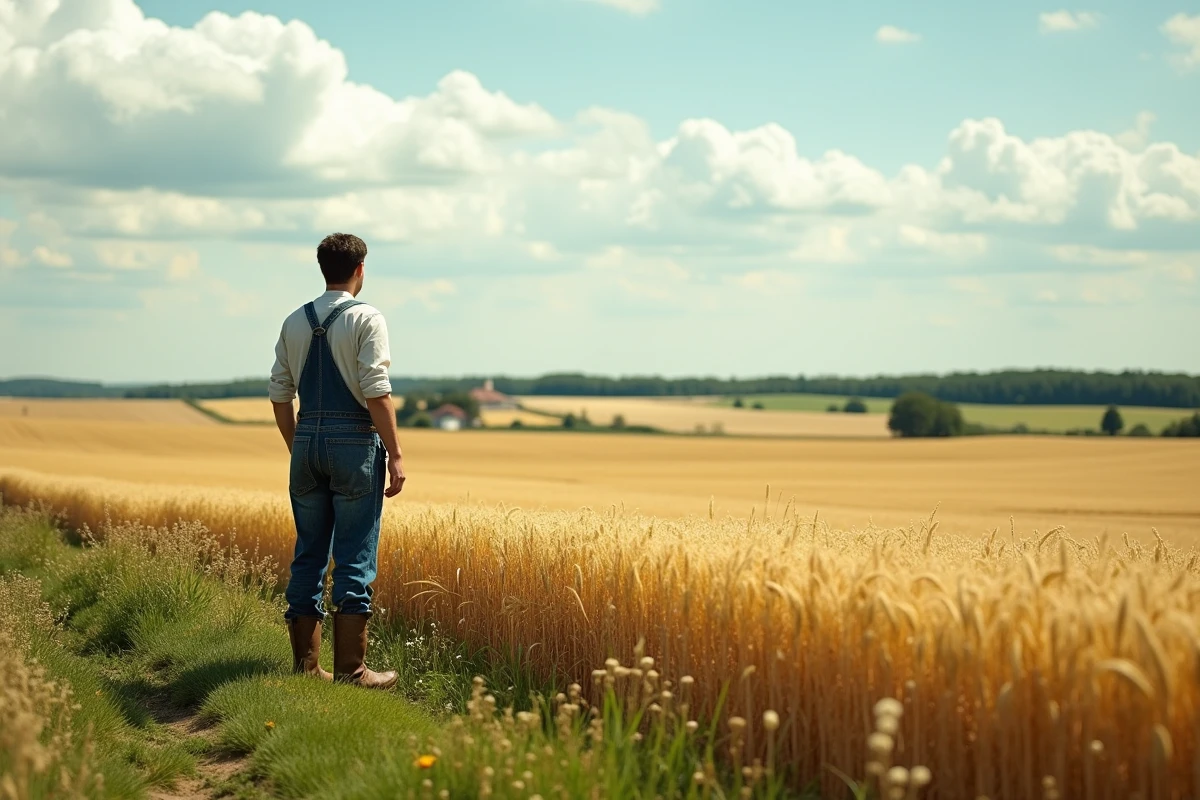
One hectare corresponds to a square with sides of 100 meters, or 10,000 square meters. Fifty hectares therefore represent 500,000 square meters, an area that most people struggle to visualize without a concrete visual reference. Converting units of measurement is not enough: to grasp this area, it must be compared to familiar elements.
To delve deeper into the visual equivalents related to this area, one can consult what 50 hectares represent according to Immobilier du Net, which details several illustrative scenarios.
Conversion of hectares to square meters: the basics to master
Before any comparison, the conversion chain needs to be clearly established. The French metric system uses three nested land units: the centiare (1 m²), the are (100 m²), and the hectare (10,000 m²).
Fifty hectares are therefore worth 500 ares, or 50,000 centiares, or even 0.5 square kilometers. This last figure is the most useful for orienting oneself on a map: half a square kilometer is a rectangle of 1,000 meters by 500, which is a stretch of land that would take about twelve minutes to walk along.
The frequent confusion comes from the transition between hectares and square kilometers. One square kilometer contains 100 hectares, not 10. The error of a factor of 10 is common in quick calculations because linear conversion (1 km = 1,000 m) is confused with area conversion (1 km² = 1,000,000 m²).

50 hectares compared to football fields
The football field remains the most commonly shared reference for visualizing an area. According to the French Football Federation, a typical competition field for adults occupies, including safety zones and peripheral strips, between 0.7 and 1 hectare.
Fifty hectares therefore equate to about 50 football fields lined up side by side. To give a concrete idea, this figure is close to the size of the largest professional training centers recorded in Europe, where several dozen pitches coexist with technical buildings.
This comparison works well because almost everyone has seen a neighborhood stadium or watched a match on television. But it reaches its limits beyond ten fields: mentally aligning fifty green rectangles becomes abstract. Hence the need to change scale.
Area of 50 hectares at the scale of a village or housing development
It is at the urban scale that 50 hectares take on their most striking dimension. Cerema shows that in many French villages with fewer than 2,000 inhabitants, the built-up area (including housing and activities) often ranges between 30 and 80 hectares for the entire village.
In other words, 50 hectares can represent almost the entirety of the urban fabric of a small village. All the houses, streets, the town hall, the school, parking lots: all fit within this area.
Equivalence in housing lots
The National Observatory of Land Artificialization documents that the average area of a lot in a recent housing development frequently ranges between 300 and 500 m² in peri-urban areas. Over 500,000 m², this gives the following order of magnitude:
- With lots of 500 m²: about 1,000 individual houses, or a complete residential neighborhood with its roadways
- With lots of 300 m²: up to 1,600 houses, which corresponds to the size of a small peri-urban municipality
- Including common spaces (roads, green spaces, facilities), the number decreases, but remains above 800 housing units in most configurations
This comparison helps to understand why the artificialization of 50 hectares of agricultural land is a major issue for local land policies: it is a miniature city emerging from the ground.
Measuring 50 hectares in a forest: the perspective of owners in the Massif Central
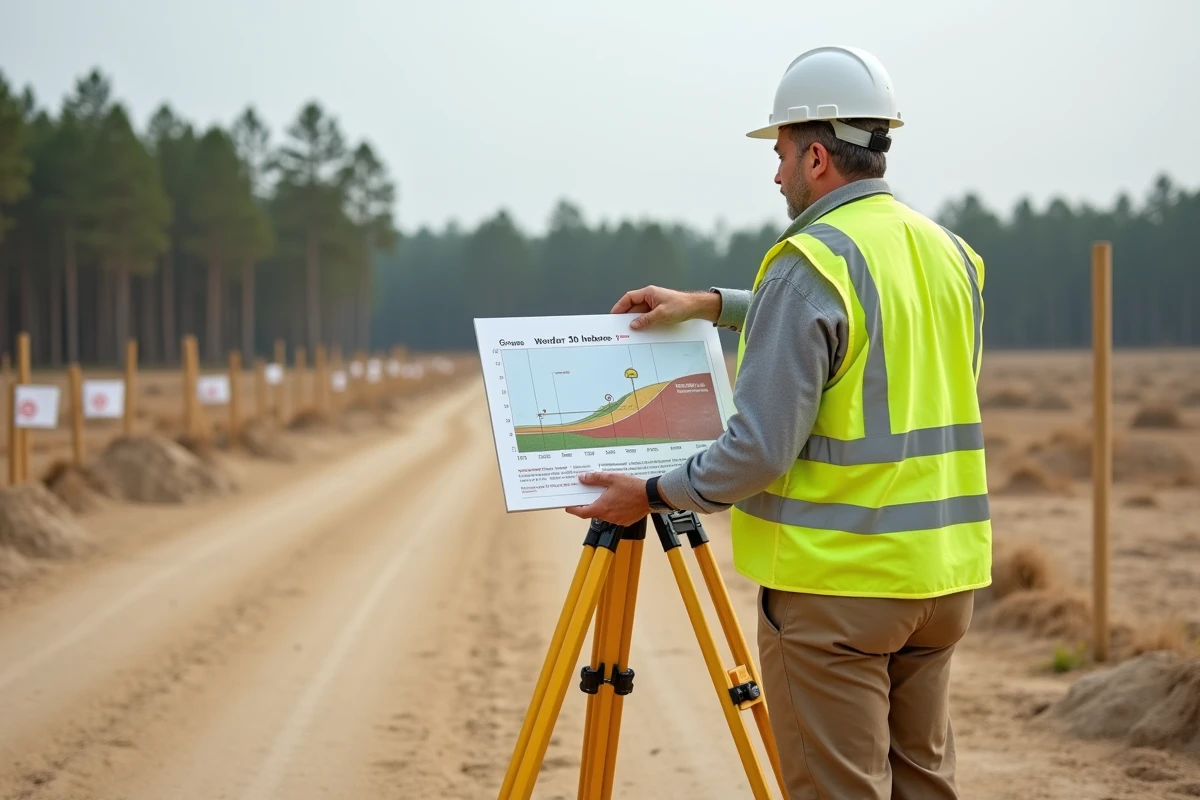
In a forest environment, 50 hectares take on a different meaning. A plot of this size far exceeds the average forest property in France, which remains very fragmented. In the Massif Central, surveys by the CNPF show that the majority of owners have much smaller areas.
Specifically, 50 hectares of forest represent a massif that takes several hours to traverse on foot while following paths. The canopy then covers an area visible from an elevated viewpoint, comparable to what one sees when looking at a wooded hillside from a village.
Visual references in a natural context
- A square of 707 meters on each side (the square root of 500,000): about the distance between two bus stops in the city
- A rectangle of 2 kilometers by 250 meters: a long strip along a river or a departmental road
- About 70 rugby fields, if one prefers this sport to football as a unit of measurement
These geometric shapes obviously vary according to the actual topography, but they help anchor the area in a mental landscape.
Hectares, ares, and square meters: summary table of conversions
| Unit | Equivalence for 50 ha |
|---|---|
| Square meters (m²) | 500,000 |
| Ares (a) | 5,000 |
| Centiares (ca) | 500,000 |
| Square kilometers (km²) | 0.5 |
This table facilitates conversion calculations between the different surface units used in notarial acts, cadastral documents, and real estate listings. The confusion between ares and hectares remains one of the most common errors in land transactions.
Remembering that half a square kilometer corresponds to the built-up area of an entire village, or to a thousand housing lots, makes the data much more tangible than a string of zeros after a number. The best unit of measurement for 50 hectares is ultimately the one that can be seen from your window.